


Báo Bình Dương điện tử - www.baobinhduong.vn
Tổng Biên tập: LÊ MINH TÙNG
Phó Tổng Biên tập: HUỲNH MINH DÂN - NGUYỄN QUỐC LIÊM


Besides cooperatives, the cooperative group model also contributes significantly to the collective economic development. Although there are many successful cooperative groups, the operation of the model still faces many drawbacks; and it is necessary to extend policies to support more effective production and business cooperation groups.
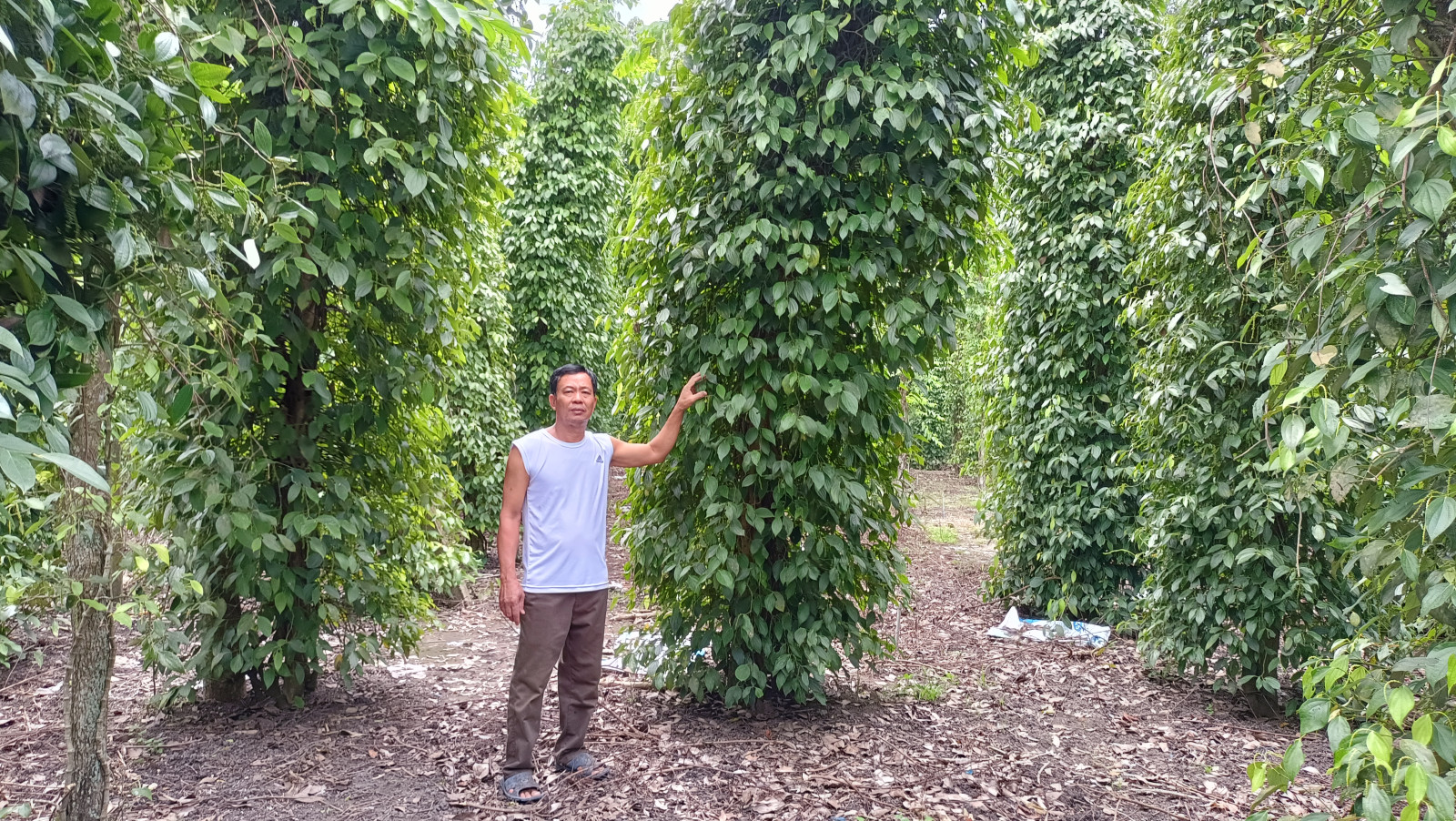
Development cooperation groups will promote people to produce and do business along the commodity value chain. In the photo: pepper growing cooperative group at An Binh commune in Phu Giao district is trying to develop typical local products
The cooperative premise
Currently, 141 cooperative groups with more than 1,263 members in the province are operating mainly in the agricultural sector. Models of cooperative groups operate in accordance with the linkage needs of smallholder farmers, among which many cooperative groups operate effectively, contributing to job creation and income improvement for rural workers. The activities of many cooperative groups have promoted production in the area by taking advantage of the local resources of land, raw materials, capital and labor resources. At the same time, household economic capacity has been gradually improving farmers' lives to make an important contribution to poverty alleviation and new rural construction.
Mr. Tran Van Chinh, Chairman of Farmers Association of An Binh commune in Phu Giao district, said: “An Binh commune has the strengths of pepper and rubber production. In order to maintain, preserve and promote local strengths as well as support farmers to overcome difficulties, in 2019 the Commune Farmers' Association propagated and mobilized people, instead of small and fragmented production, to form a cooperative group to grow pepper. Commune People's Committee, Farmers' Association offer loans, open training courses on science and technology, support to buy fertilizers with deferred payment. By 2020, the cooperative model of pepper growing groups will meet Global GAP standards. In order for cooperative models to develop sustainably and operate more effectively, it is necessary to steer by a competent captain.
For large-scale cooperative groups, a diversified and effective organizational form is an important premise to develop into cooperatives. Typically, Kim Long Hi-tech Agriculture Cooperative at Ca Na hamlet of An Binh commune in Phu Giao district started as a cooperative group specializing in cantaloupe with 8 members. Thanks to its efficient operation and high economic profit, the locality has mobilized to develop into a cooperative model. Up to now, the cooperative is an advanced example of the largest hi-tech cantaloupe growing model in Phu Giao district with 45 members and nearly 30 employees. The average revenue of the cooperative is VND 7.5-9 billion a year; the average income of cooperative members is more than VND 20 million a month a person; the average income of employees is VND 6 million a month.
Also developed from a pomelo growing cooperative group with 12 members, Bach Dang pomelo cooperative at Bach Dang commune in Tan Uyen town since its operation with the cooperative group model has brought hundreds of millions of VND each year for members. Following the previous achievements, starting from 2018 officially operating under the cooperative model, Bach Dang pomelo cooperative increasingly affirms its quality reputation to bring its products far into the markets.
In fact, an effective cooperative group is a solid foundation for moving towards the cooperative model of sustainable development. According to the assessment of the provincial Cooperative Union, the cooperative groups have made practical contributions to the socio-economic development in the locality, being a source for the development of cooperatives. At present, the number of development cooperation groups has been raised to cooperatives; the old cooperatives have basically been transformed, and many new cooperatives have been established to practice more efficient production and business operations.
To formulate the appropriate policies
Recently, the number of cooperative groups has increased rapidly in many localities, most of which were established from socio-political organizations of communes, wards and townships. Although certain advantages are visible, in reality, the production of cooperative groups still has many problems.
Cooperative organizations are limited in both capacity and competitiveness compared to other economic models. In addition, the majority of managers of cooperative groups have limited qualifications and operating capacity as operating according to their own experience. In particular, cooperative groups do not have legal status, so it is difficult to access policies to encourage, support and develop, especially preferential loans. To sign contracts with partners, groups must go through the commune People's Committee, which limits their ability to operate, cooperate, develop production and business operations. Therefore, the formulation of policies in line with development needs will help the economic model have a clear production and business plan.
At the conference summarizing 10 years of implementation of the Law on Cooperatives 2012 pointed out the need to amend it into the Law on cooperative economic organizations. Additional subjects of application are cooperative groups, unions of cooperatives, cooperative economic groups and members of cooperative economic organizations. The addition of objects, including cooperative groups, will ensure complete and consistent regulations for economic cooperation organizations in a legal document. Along with the appropriate amendment of the law, cooperative groups that want to develop also need the support from the government and related applications to increasingly improve the value of all aspects of the economic model.
Reported by Tien Hanh – Translated by Vi Bao