
Báo Bình Dương điện tử - www.baobinhduong.vn
Tổng Biên tập: LÊ MINH TÙNG
Phó Tổng Biên tập: HUỲNH MINH DÂN - NGUYỄN QUỐC LIÊM


U.S. President Barack Obama sent Congress a 3.83-trillion-dollar budget in fiscal year 2011 on Monday to boost the fragile economic recovery, with a record- breaking 1.56-trillion-dollar deficit in fiscal year 2010 ending in September.
The budget shortfall in 2010 would equal an unsustainable 10.6 percent of the gross domestic product (GDP), the basic measure of a country's overall economic output.
The White House said the 3.83 trillion dollars budget of 2011 is aimed at dealing with the aftermath of the financial, fiscal, housing and unemployment crises, and to lay the foundation of sustainable growth of the U.S. economy.
"This budget embodies the president's efforts to deal with all those situations," said Obama's communications director Dan Pfeiffer, who said the budget contained "tough choices" in a bid to curb spending.
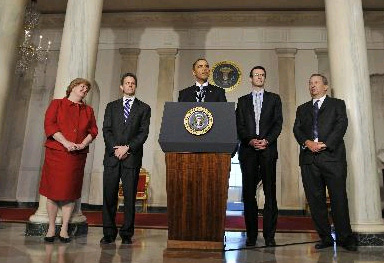
U.S. President Barack Obama (C) speaks on the 2011 budget at the Capitol Hill in Washington Feb. 1, 2010.(Xinhua/Zhang Jun)
In an effort to fight unemployment crisis, Obama proposed a 100 billion dollars jobs measure that would provide tax breaks to encourage businesses to boost hiring as well as increased government spending on infrastructure and energy projects. He called for fast congressional action to speed relief to millions left unemployed in the worst recession since the 1930s.
On the anti-recession front, Obama's new budget proposed extending the popular Making Work Pay middle-class tax breaks of 400 dollars per individual and 800 dollars per couple through 2011. They were due to expire after this year.
The budget also proposes making 250 dollars payments to Social Security recipients to bolster their finances in a year when they are not receiving the normal cost-of-living boost to their benefit checks because of low inflation. Obama will also seek a 25 billion dollars increase in payments to help recession-battered states.
The Department of Homeland Security would get an additional 734 million dollars to support the deployment of up to 1,000 advanced imaging airport screening machines and new baggage screening equipment to detect explosives. Those increases represented a response to the Christmas Day bombing attempt on an airliner landing in Detroit.
The president's budget seeks a 33 billion dollars increase in a supplemental appropriation this year for the military and 159.3 billion dollars in 2011 to support Obama's boost strategy to deal with the terrorist threat in Afghanistan and Pakistan.
Aiming at the longer-run competitiveness, the Obama administration proposes to boost education spending.
The administration said it was proposing the largest funding increase in the history of the Elementary and Secondary Education Act, a 3 billion dollars increase to 28 billion dollars plus an additional 1 billion dollars if Congress agrees to some major changes in the law.
The new budget would also provide an additional 1.35 billion dollars for the president's Race to the Top challenge, a federal grant program in which 40 states are competing for 4 billion dollars in education money included in last year's stimulus bill.
However, the record-breaking deficit has aroused wide concerns. The Obama administration pledged to control deficit after the economy recovery stands on a firm footing.
The government forecasted the deficit will fall to 1.267 dollars in 2011, but the deficit to GDP ratio remains much higher than the sustainable level of about three percent.
In order to control deficit, the administration proposed a three-year freeze on spending beginning in 2011 for many domestic government agencies excluding security and social safety net programs. It would save 250 billion dollars over the next decade by following the spending freeze with caps that would keep increases after 2013 from rising faster than inflation.
The surge in the deficits reflects not only the increased spending but also a big drop in tax revenues, reflecting the 7.2 million people who have lost jobs since the recession began and weaker corporate tax receipts.
Although the Obama administration vowed to fight deficit, economists say that it will take longer time for the U.S. government to return to fiscal discipline.
The Heritage Foundation, a Washington-based think tank, said that the Obama budget only means higher taxes, higher spending and more debt.
Xinhua