
Báo Bình Dương điện tử - www.baobinhduong.vn
Tổng Biên tập: LÊ MINH TÙNG
Phó Tổng Biên tập: HUỲNH MINH DÂN - NGUYỄN QUỐC LIÊM


The COVID-19 pandemic has caused heavy damage to the global economy. However, the post-COVID-19 period will bring a golden opportunity for the growth of cross-border e-commerce. To take advantage of this opportunity, all levels, sectors and business community are seeking to make a push for development.
To keep pace with market trends
While all industries are heavily affected by the pandemic, e-commerce has been evaluated as a "bright spot" with a high growth rate. According to Phan Thi Khanh Duyen, Deputy Director of provincial Department of Industry and Trade, sale through e-commerce channels is one of the fastest ways for companies to build their own brands. Then goods export and business expansion would not have to bear high investment costs. Cross-border e-commerce is becoming an effective way for Vietnamese enterprises to open the door to global supply chain. However, in order for products of Binh Duong to connect effectively with the global market, a leveraged solution is needed. In particular, e-commerce is the key issue that companies must really take part in and adapt to this inevitable trend.
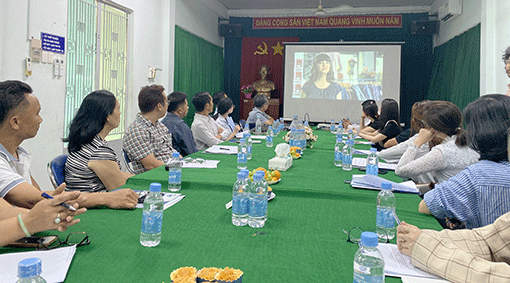 Ceramic and handicraft enterprises making consider and select virtual market models at a conference.
In 2020, despite of many difficulties and challenges, Binh Duong retained good economic growth. GRDP of the province increased by 6.78%; GRDP per capita reached $6,500. Economic structure of the province continued to shift favorably towards gradually increasing the proportion of services and industrial production, accounting for more than 96%. Export turnover reached $27.4 billion; import turnover reached $21.5 billion; trade surplus reached nearly $6 billion. In which, many key export industries of the province caught the market's rhythm, quickly developed e-commerce.
Nguyen Phuc, Vice Chairman of Binh Duong Furniture Association (BIFA), said that the impacts of COVID-19 caused many difficulties to the wood processing and exporting industry in the first half of 2020. Main products of this industry stood still, due to interruption of consumption chain for wood products. In the difficult context, businesses in the whole industry continuously created, researched and changed many methods, forms of marketing and sales to expand the market. Instead of solely being known through direct sales channels and fairs, companies actively switched to online channels and set up their digitalization. Enterprises strengthened online connections through online sales channels around the world, such as Alibaba, Amazon... BIFA immediately made suitable orientations for companies within the industry. Namely, we postponed annual fairs and exhibitions, carried out digital transformation to support businesses in putting their products onto e-commerce floors. Accordingly, BIFA and a number of local wood processing associations signed a cooperation agreements with FPT to set up digitalization for the wood processing industry and handicrafts in Vietnam.
On this platform, furniture manufacturers and processors in Vietnam are able to display their products and open virtual reality showrooms. Accordingly, customers can visit showrooms, search for specific products with 2D-, 3D-images, and directly contact the sellers through connection tools available on the platform. Once launched, this platform has received the attention and active participation of many wood companies across the country. This is a channel connecting and trading between manufacturers, distributors and consumers.
Ly Chau Lam, Director of Tan Toan Phat Ceramics Company (Tan Uyen Town), said that ceramic enterprises have been promoting digital transformation and smart marketing. In particular, trade promotion activities through e-commerce environment play an increasingly important role, supporting enterprises to grow exports. Currently, companies focus on researching, implementing and adjusting their operations to be suitable to practical situation. In the digitalization process, enterprises are also interested in choosing appropriate products and technologies. Next, they accelerate digitization, build databases for operations and prepare their human resource...
A potential playground
According to Tina Phan, Indochina Regional Director, Hong Kong Trade Development Department, the pandemic on a global scale has caused negative impacts on the general socio-economic development and business activities in particular. In this particular context, online sales channels play an significant role, becoming one of the safest ways for consumers to purchase essentials as well as businesses to maintain production activities. Recently, in order to support enterprises confidently participate in this new and potential playground, Hong Kong Trade Development Department has made great efforts to connect SMEs for trade promotion to Hong Kong market.
Trinh Hong Quyet, Director of Kim Long Cantaloupe Cooperative (Phu Giao district) said that e-commerce skills of some companies are still limited, IT infrastructure has not yet developed, facing language barriers. To facilitate e-commerce development and help companies penetrate the global value chain, supports to businessess are in need, namely, in developing skilled human resources, forming an ecosystem for e-commerce and digital economy. It is necessary to build a number of national e-commerce sites associated with Vietnamese brands so that global consumers can easily find them, and at the same time create an online commerce platform for Vietnamese enterprises to introduce products and reach international market.
Besides economic development, Binh Duong has also actively expanded international cooperation relationships. Up to now, Binh Duong has established bilateral cooperation relationships with 10 foreign provinces and cities. Binh Duong was the first locality in Vietnam to officially become a member of the World Intelligence Community Forum (ICF). In three consecutive years, Binh Duong was honored by ICF to be one of the 21 regions that have the world's exemplary smart city development strategies (SMART 21). In its development strategy, Binh Duong will continue to implement the project "Binh Duong Innovation Region" with the planning for a Scientific and Technological Industrial Park, building a creative start-up ecosystem, increasing proportion of services, especially e-commerce and international trade, with a model project of World Trade Center in Binh Duong New City.
Reported by Tieu My - Translated by Ngoc Huynh