

Báo Bình Dương điện tử - www.baobinhduong.vn
Tổng Biên tập: LÊ MINH TÙNG
Phó Tổng Biên tập: HUỲNH MINH DÂN - NGUYỄN QUỐC LIÊM


In addition to the advantages gained when joining Free Trade Agreements (FTAs), a thorough understanding of trade defense law is considered as a legitimate and effective tool to support domestic industries while competing in the international arena.
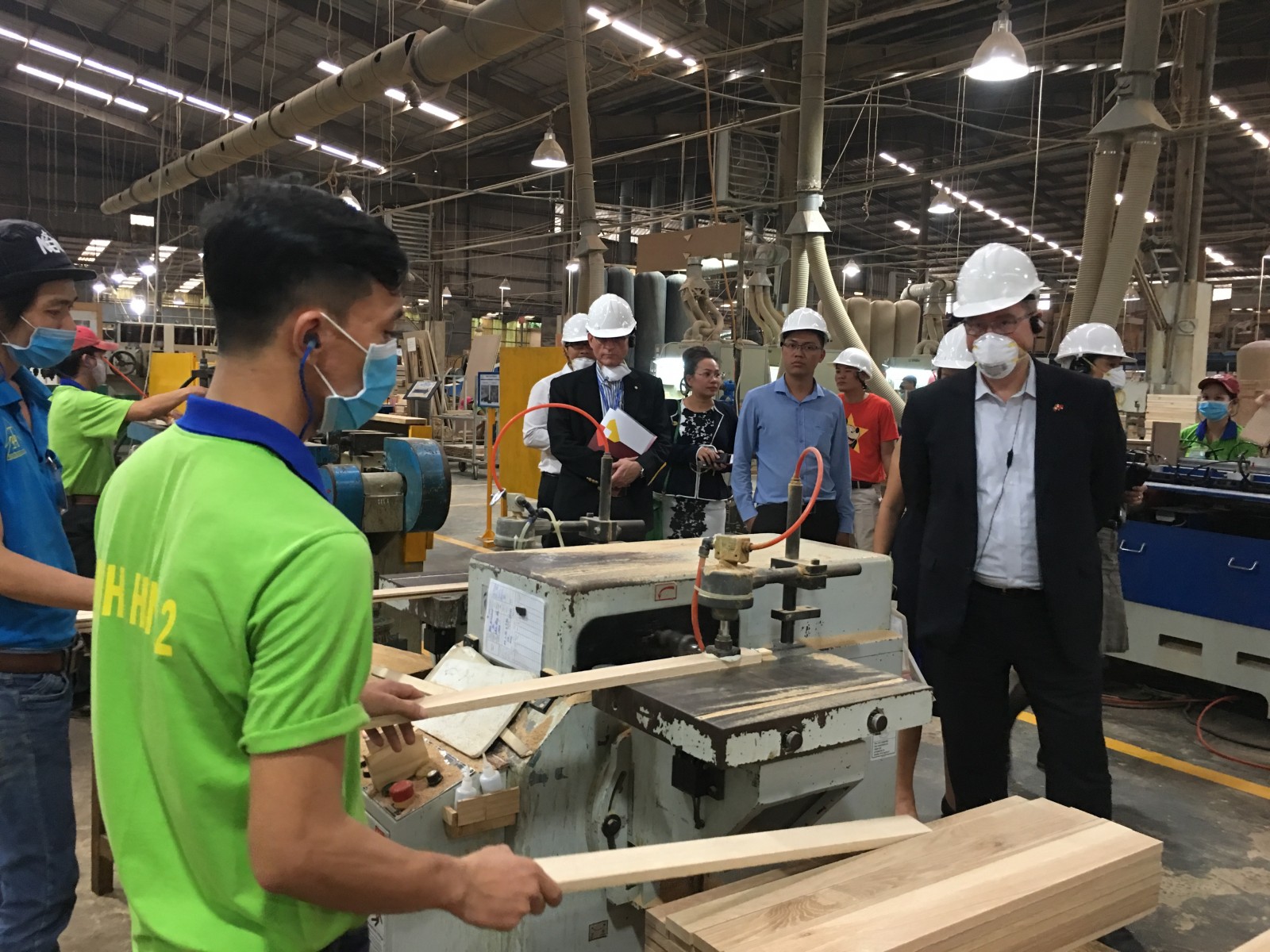
A Swiss partner visits Wood Processing Factory of Tien Hung Company (Thuan An City).
To ascertain the regulations
Owing to the fact that Vietnam has participated in many FTAs, such as ASEAN, ASEAN+, and most recently EVFTA, trade defense remedies are increasingly playing an essential role in the economy as well as manufacturing sectors, and domestic enterprises, contributing to the goal implementation of improving effectiveness of the international integration process.
According to Department of Trade Defense (Ministry of Industry and Trade), out of 13 products are at risk of trade defense investigation or investigation against tax evasion of major markets, such as the US, Europe and Canada, Vietnamese plywood was warned at level 4, the highest level. This fact has worried many wood export enterprises. According to Dien Quang Hiep, Chairman of Binh Duong Furniture Association (BIFA), the wood industry is worried about anti-dumping tax being imposed on some domestic wood products by several foreign markets. Currently, the two items with the highest risk are kitchen cabinets and plywood. If there is no measure to prevent foreign wooden products disguised as Vietnamese wood products for export, the risk to wood industry is huge.
Recently, Trade Defense Department has sent an express dispatch to wood processing associations to announce that the US Hard Plywood Fair Trade Union had requested the US Department of Commerce (DOC) to investigate the levy of anti-evasion and anti-dumping duties on hard plywood products exported from Vietnam. Not only for the US market, Korean Ministry of Trade, Industry and Energy also issued a decision to propose Korean Ministry of Economy and Finance to impose an anti-dumping tax from 9.18 to 10.65% on plywood imported from Vietnam. When making the above decision, Korean Ministry of Trade, Industry and Energy stated that the price of plywood products imported from Vietnam was quite abnormal, adversely affecting Korean plywood industry. Korean plywood market currently has a scale of approximately 900 billion Won, of which, plywood imported from Vietnam accounts for 45%.
In this situation, BIFA recommended that the prime measure is that relevant ministries, agencies and localities should speed up the review and inspection to eliminate investment projects having the purpose of borrowing Vietnamese origin. Vietnam Ministry of Industry and Trade, Chamber of Commerce and Industry need to tighten the issuance of certificates of origin (C/O), especially as granting C/O to Chinese-invested enterprises, exported plywood, kitchen cabinets, especially to the US, South Korea.
Textile and apparel industry, besides the Covid-19 crisis, is worried about the dependence on raw and auxiliary materials of China and these materials are not accepted by the European market. To overcome this, Textile and Apparel Association said that for non-outsourcing businesses, there are two options. One is to self-produce fabrics or buy local raw materials. The second is to import raw materials from countries in bilateral trade agreements with Europe, such as Korea, Turkey. However, this is a matter of great consideration to textile and garment industry, when the product cost will be very high, reducing the competitiveness of Vietnamese products. Another problem of the textile and apparel industry is that most enterprises exporting to the EU are small and medium-sized enterprises (SMEs) that have limited resources. Their production processes are not up to EU standards. These SMEs make inadequate investment in research and development, have not efficiently exploited intellectual property assets, trademarks; are not knowledgeable about laws, have not reached foreign language proficiency and professional trade promotion skills.
Representatives of steel manufacturers also affirmed that trade defense is increasing in the current integration context. In particular, lawsuits come from main export markets of Vietnam, such as ASEAN countries, the US, EU... Accordingly, after such lawsuits, Vietnamese enterprises will be greatly affected in exports.
To actively propose solutions
Along with trade defense remedies, to facilitate export activities, enterprises need to proactively make suggestions to authorities to protect their legitimate interests. In early August 2020, Vietnam Timber and Forest Products Association proposed to the customs authority to issue a document on re-applying HS code to laminated timber for export. This was a testament to the active role of wood industry in talking with authorities. The General Department of Customs discussed with businesses, trade associations, and related agencies to determine the production and processing process of products, specifications used to decide HS code suitable to the group of rubber wood products for export.
Moc Cat Tuong Company (Dong Nai) disagreed with classification results and requested the reconsideration to classify items in heading 44.18 or heading 44.21 (subject to 0% export tax). Sharing the same point of view, Huynh Quang Thanh, CEO of Hiep Long Company (Thuan An City), said that Ministry of Finance had previously issued Official Letter 9365 / BTC-VCST dated July 1, 2009 providing guidance on HS code classification of wooden boards. The classification of group 44.07 has a negative impact. It is necessary for enterprises to export at 0% tax rate.
Luu Manh Tuong, Deputy Director of the General Department of Customs, affirmed that the customs continued to verify the manufacturing and processing of products, product specifications on specific, open, transparent, and fair principles to decide an appropriate HS code for the products. In order to solve and support enterprises to solve problems, Mr. Tuong suggested customs agencies, where the enterprises register export procedures, to create the best conditions for enterprises to export goods as usual, and the immediate tax rate is 0%.
Reported by Tieu My - Translated by Ngoc Huynh